
Topic 2.3
Supply
This topic covers supply of goods and services by producers, and the factors that influence it. You also learn about supply curves, and Price Elasticity of Supply (PES).
What is Supply?
-
Supply is the willingness and ability of a producer to sell a good or service at a given price and a given time period.
-
On the right is a supply curve, which is upward sloping, due to the Law of Supply, which states that the quantity supplied (QS) for a product varies directly with the price - as price increases QS increases as producers will be willing to sell more and get more revenue, also for covering the increased cost of production for producing more output
-
Individual supply is the supply for a good or service by a single consumer, while market supply is the total supply for a good or service in a given time period found by adding together all of the individual supplies. In exams, supply curves typically show market supply, unless they state otherwise
-
This positive relationship is shown by the supply curve, which slopes upward from left to right.

Changes to the Supply Curve
Movements along the supply curve
[Diagram Placeholder: Movements]

Shifts of the supply curve
[Diagram Placeholder: Shifts]

A change in price leads to a movement along the existing supply curve. When price rises, supply expands, resulting in a lower quantity demanded and reduced revenue. When price falls, supply contracts, decreasing the quantity demanded and raising revenue. This relationship is explained by the Law of Supply
Movements are only caused by changes in price.
A supply curve can only shift due to certain non-price factors (listed below). It will either result in a shift to the right in supply which is an increase in supply (from S1 to S3 on the above diagram) or a shift to the left which is a fall in demand (from S1 to S2).
Note: when drawing the first new supply curve, label it S2.
Shifts of the supply curve: non-price factors
A shift in the supply curve is always caused by a non-price factor, and they are listed below
Costs of Production - If production costs rise, firms can make less profit, so they supply less at every price, causing the supply curve to shift left (and vice versa)
Subsidies - Subsidies lower firms’ costs of production as the government has given them money to produce, so they are able to supply more at each price and the supply curve shifts right
Technology - Improved technology makes production more efficient and cheaper, so supply shifts right.
Number/Size of Firms - An increase in the number or size of producers raises market output, so market supply shifts to the right.
Taxes - Higher taxes increase firms’ costs of production, so they supply less at each price and the supply curve shifts left
Climate - Bad climate conditions, such as drought or flooding, can reduce output, so supply shifts left
Price Elasticity of Supply
PES is the responsiveness of quantity supplied to change following a change in price.
[ Image Area Reserved ]

Note: Due to the law of supply, PES values are always positive.
Formula
Inelastic and Elastic Supply
Inelastic supply

Elastic supply

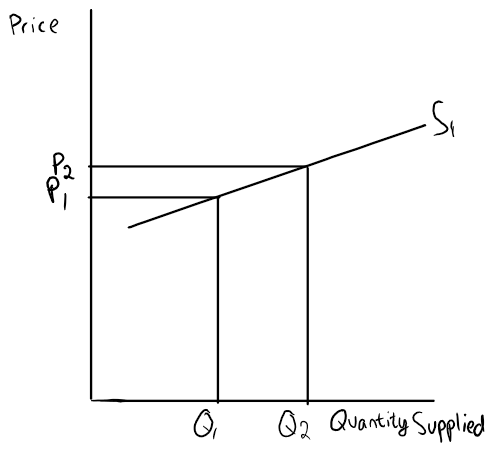
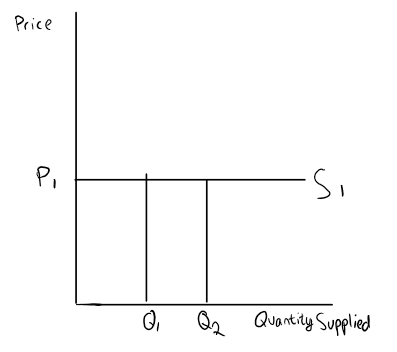
Inelastic supply is when the percentage change in quantity demanded is lower than the percentage change in price. Inelastic supply is always between 0 and 1.
-
Essentially, when price changes by a lot, there is a small change in quantity
-
Elastic supply is better from a firm's perspective, because they can easily change their supply to match changes in demand
-
This makes inelastic supply worse from both a consumer and producers' perspective as the firm will not be responsive and wi
Inelastic
Perfectly Inelastic
Elastic
Elastic supply is when the percentage change in QS is greater than the percentage change in price. Elastic supply is always greater than 1
-
When price changes by a little, there is a large change in QS.
Perfectly Elastic
Determinants of PES - "BRITS"
B
High barriers (e.g., regulations, or high start-up costs) make it difficult for new firms to enter the market, keeping supply price inelastic. Low barriers make supply price elastic
Barriers to Entry
R
Raw Materials
If raw materials and components are readily available and widely accessible, a firm can rapidly expand production, making supply more elastic
I
Firms with a large inventory (finished goods and components) can easily increase supply and hence have elastic supply. Perishable goods hence have inelastic supply as they go bad fast.
Inventory (Stock)
T
Supply is always elastic in the long-run as firms can buy more factors of production to change their supply. Supply is hence inelastic in the short-run as productive capacity is fixed
Time Period
S
Spare Capacity
If a business is operating below its maximum output, it has unused resources and can increase supply easily. If factories are running at 100% capacity, supply is inelastic
How firms can increase elasticity of supply
Investing in new technology and capital equipment allows firms to increase production speeds and respond faster to price signals.
Improving the flexibility of labor through training ensures workers can switch roles or increase output during peak demand periods.
Holding higher levels of stock (inventory) provides a buffer, allowing the firm to supply the market immediately if prices rise.
Increasing spare capacity, allows a firm to quickly increase production without facing higher costs, making its supply more price elastic.
Diversifying production processes to allow for switching between different products quickly when market values change.
How spare capacity can be increased:
-
Reducing current output so that there are unused resources
-
Increasing efficiency
-
Investing into new factors of production (e.g. labour/capital)
Evaluating the importance of PES to consumers
Points
Evaluations
-
Availability of goods - PES allows consumers to understand availability, meaning that they know how easy it is to purchase a good. This means that if a good has inelastic PES, such as tickets for a sporting event or concert, consumers can try to buy it as quickly as possible to ensure that they get the good - goods harder to get
-
Reliability - PES allows consumers to know how reliable a firm is. This means that if a firm has inelastic PES, it will lead to having less stock, so they will be less responsive to a change in demand. This means that consumers should look for companies with elastic PES as they are reliable. This means that they will rarely be out of stock, meaning that the consumers will always get the good they need.
-
Volatility - Price elasticity of supply (PES) shows how much supply changes when price changes, which helps consumers and firms judge how stable prices are likely to be. When supply is elastic, prices tend to be more stable; when supply is inelastic, prices are more volatile, so consumers may look for substitutes earlier to avoid sudden price rises or falls
-
Difficult to calculate - PES data is often unavailable to the average consumer which means that they will not be able to infer this.
-
Low prices > reliability - However, some consumers may prefer low prices. This means that if a firm has low prices, but still has inelastic PES, then many consumers will not care about reliability and the chance of being out of stock. Some people will not be serving repeat buyers so low prices is even more important
-
Disposable income (rich people)- However, consumers may have a lot of disposable income. This means that they are quite rich. This means that they would not care as much about a price change, because they can still afford it. This means that PES is unimportant to them. [This point is only good to use if this can be inferred from context clues in the case study]
Evaluating the importance of PES to producers
Points
Evaluations
-
Reliability and ability to react to market changes - Firms want elastic PES because it lets them quickly raise or cut output in response to price changes, helping them make more profit or reduce losses. It also gives them flexibility to test new products and scale up the ones that sell well
-
Elastic PES - shows reliability because they can easily react to changes and they will rarely be out of stock. This means that they will not be sold out of stock during demand spikes and production can be ramped up fast. This means that consumers are more likely to stay with the firm instead of switching, so more revenue in long-term
-
If PES is inelastic then price is almost entirely dependent on demand, signalling to producers that they need to increase their elasticity. A change in demand would cause a high change in price because supply can’t be increased or decreased so easily so quantity pretty much stays the same. In the situation of an increase in demand, price would increase to meet the new equilibrium but since supply is inelastic, supply wouldn’t also rise.
-
Monopoly - A dominant firm is a price‑maker and faces limited competitive pressure. Its primary concern is the elasticity of demand and maximising profit, rather than ensuring a highly elastic supply response. Even if its PES is relatively inelastic, the lack of close substitutes means it can still raise price and restrict output without losing significant market share, so it has less incentive to adjust its spare capacity simply to make supply more elastic.
-
Non repeat buyers will not care about reliability. Also, low prices are often more important than reliability.
-
Long-term elasticity - PES is elastic in the long-term because of variable inputs as firms can hire labour or invest in capital or any factor of production in order to increase spare capacity, so short-term inelasticity might not matter. Firms with long-term plans will not care that much about a short-term inelasticity
-
💡
Key Tip: Each year in Paper 1, a 6-marker on one of PED or PES is asked. Therefore it is extremely important that you know the tables for both.